s
If you are asking, “How do I know if my bag is waterproof?”, the answer is not just about whether water beads on the surface.
A bag may look waterproof in photos, feel thick in your hands, or survive a few drops of rain. But that does not always mean it can protect your phone, clothes, camera, documents, or travel gear in real wet conditions.
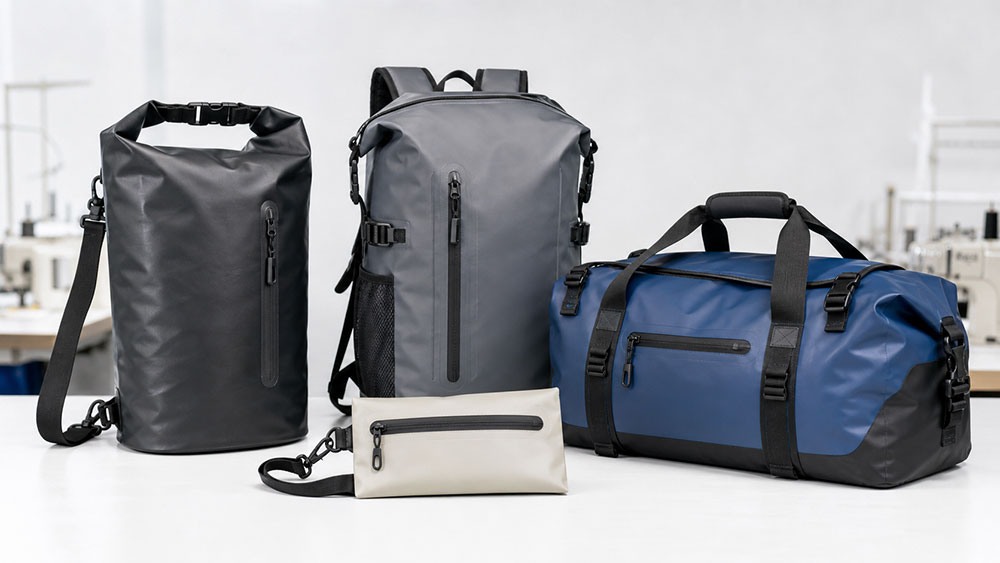
Some bags can handle light rain. Some can protect your gear from splashes on a boat or at the beach. Some roll-top dry bags can handle short water exposure when closed correctly. Only specific bags with tested ratings or fully sealed construction should be trusted for submersion.
This guide gives you a practical checklist for checking whether your bag is waterproof, water-resistant, or only water-repellent. You will learn what to look for in the label, material, seams, zipper, closure, and how to do safe water tests without damaging your gear.
For a deeper explanation of waterproof construction, you can also read our guide on what makes waterproof bags truly waterproof.
Quick Waterproof Bag Inspection Checklist
A bag is more likely to be waterproof if it has waterproof materials, sealed or welded seams, a roll-top closure or waterproof zipper, reinforced corners, and a clear waterproof rating or test claim from the brand.
A bag is probably only water-resistant if it has regular zippers, stitched seams, fabric lining, exposed needle holes, or a water-repellent coating but no sealed construction.
| What You Check | Waterproof Bag | Water-Resistant Bag | Not Waterproof |
|---|---|---|---|
| Material | PVC, TPU, tarpaulin, coated waterproof fabric | Coated nylon or polyester | Cotton, canvas, untreated fabric |
| Seams | Welded, taped, or sealed | Stitched with some coating | Regular stitched seams |
| Closure | Roll-top, waterproof zipper, airtight zipper | Flap cover or water-resistant zipper | Open zipper or drawstring |
| Water behavior | Water beads and does not soak through | Handles light rain for a short time | Absorbs water quickly |
| Best use | Kayaking, boating, beach, rain, wet storage | Commuting, light rain, daily use | Dry weather only |
| Submersion | Only if rated or designed for it | No | No |
Tip: Do not judge a bag by one feature alone. A waterproof material with a regular zipper may still leak. A water-repellent fabric may bead water on the surface but fail at the seams.
Waterproof, Water-Resistant, and Water-Repellent: What Is the Difference?
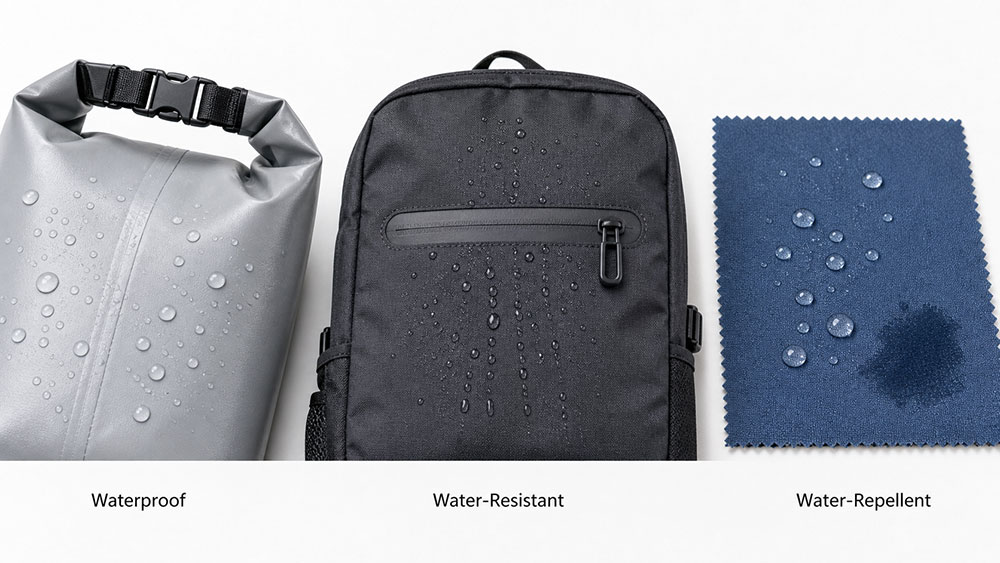
Before checking your bag, it helps to understand the terms.
Waterproof
A waterproof bag is designed to stop water from entering under specific conditions. It usually uses waterproof materials and sealed construction.
Examples include roll-top dry bags, welded waterproof backpacks, waterproof phone pouches, and waterproof duffel bags.
However, “waterproof” does not always mean the bag can be submerged for a long time. A waterproof dry bag may protect your items from rain, splashes, and short accidental water exposure, but full submersion depends on the design and rating.
Water-Resistant
A water-resistant bag can resist water for a short time, but it is not fully sealed.
It may protect your belongings in light rain, but water can eventually enter through seams, zippers, stitch holes, fabric openings, or the top closure.
Many everyday backpacks, laptop bags, travel bags, and commuter bags are water-resistant rather than fully waterproof.
Water-Repellent
Water-repellent usually refers to a surface treatment. Water may bead up and roll off at first, but the bag is not necessarily waterproof.
A water-repellent finish can wear off over time, especially after abrasion, washing, UV exposure, or heavy use.
In simple terms, water-repellent treatment helps the surface shed water, while waterproof construction focuses on stopping water from entering through the material, seams, zipper, and closure.
1. Check the Product Label or Description
The easiest first step is to check the product label, hangtag, packaging, or online product description.
Look for terms such as:
- Waterproof
- Fully waterproof
- IPX-rated
- Submersible
- Welded seams
- RF welded
- High-frequency welded
- Taped seams
- Roll-top closure
- Waterproof zipper
- Airtight zipper
- PVC
- TPU
- Tarpaulin
- Dry bag
Be careful with vague terms such as:
- Weatherproof
- Splash-resistant
- Water-repellent
- Rain-resistant
- Water-resistant coating
- Outdoor fabric
These terms can still be useful, but they do not always mean the bag is fully waterproof.
If the description says “water-resistant,” treat the bag as suitable for light rain or occasional splashes, not full water exposure. If it says “waterproof,” check whether the product also explains the structure, material, seam sealing, zipper type, or test rating.
Tip: A reliable product description should tell you how the bag is waterproof, not just say the word “waterproof.”
2. Look at the Material
Material is one of the biggest clues.
Waterproof bags often use materials that do not absorb water easily, such as PVC, TPU, PVC tarpaulin, TPU-coated fabric, or clear PVC. These materials are common in dry bags, waterproof backpacks, waterproof pouches, phone pouches, and marine bags.
| Material | Waterproof Potential | Common Bag Types |
|---|---|---|
| PVC | High when welded or sealed | Dry bags, duffel bags, waterproof pouches |
| TPU | High when welded or sealed | Premium dry bags, soft waterproof pouches |
| PVC Tarpaulin | High and durable | Heavy-duty waterproof backpacks and duffels |
| Clear PVC | High when sealed properly | Phone pouches, cosmetic pouches, document bags |
| Coated Nylon | Medium to high depending on seams | Lightweight outdoor bags |
| Canvas | Usually low unless heavily treated | Fashion bags, casual totes |
| Regular Polyester | Usually low unless coated | Daily backpacks, school bags |
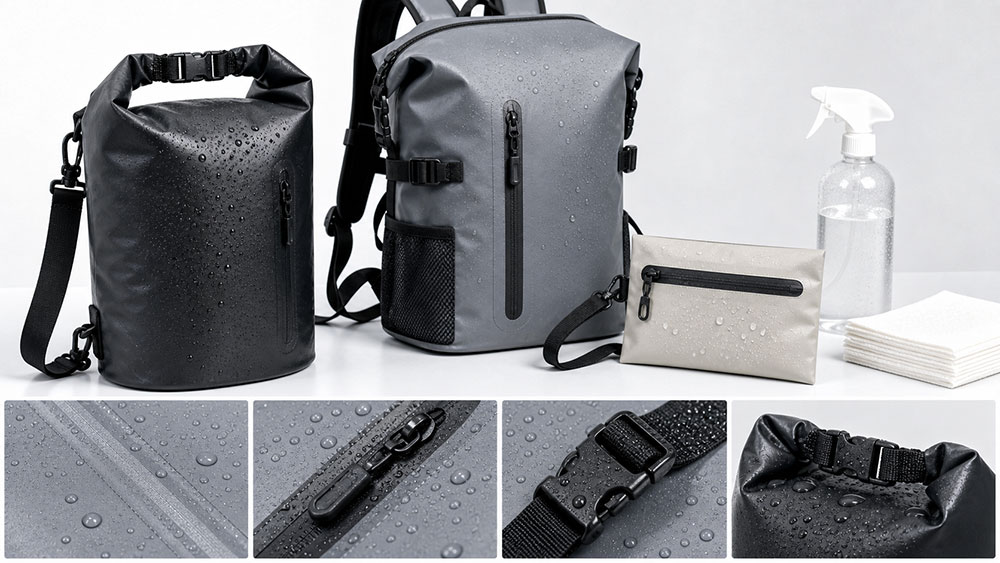
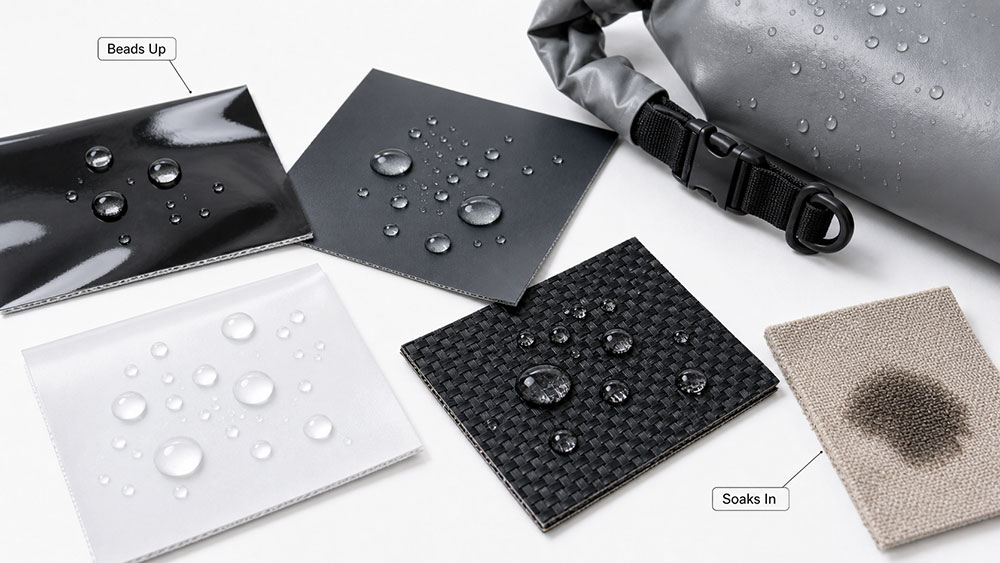
A simple surface test can help. Put a few drops of water on the material. If water beads up and stays on the surface, the material has some level of water resistance. If the water darkens the fabric and soaks in quickly, the bag is not waterproof.
But remember: waterproof material alone does not make the whole bag waterproof. Water often enters through seams, zippers, openings, and corners.
3. Inspect the Seams
Seams are where many bags fail.
A regular stitched seam creates needle holes. Even if the fabric is waterproof, water can pass through those tiny holes unless the seam is taped, sealed, or covered.
A waterproof bag usually has one of these seam structures:
- RF welded seams
- High-frequency welded seams
- Heat-welded seams
- Taped seams
- Sealed seams
- Bonded seams
For waterproof dry bags and many welded waterproof bags, welded seams are especially important because they join compatible materials without traditional stitching holes.
To inspect your bag, turn it inside out if possible and look at the seam area.
If you see regular stitching with no seam tape, welding line, or waterproof barrier, the bag is probably not fully waterproof.
If you see smooth welded lines, sealed strips, or tape covering the seams, the bag has better waterproof potential.
Tip: Seams are often more important than fabric thickness. A thick bag with unsealed stitched seams can still leak.
4. Check the Closure
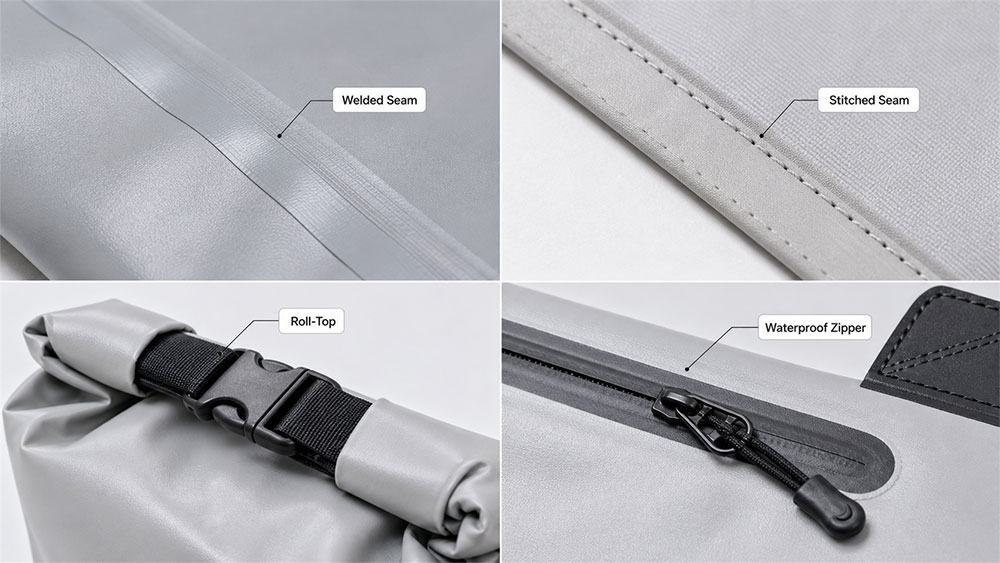
The closure is just as important as the fabric.
A bag with waterproof fabric but a regular zipper opening is usually not fully waterproof. Water can enter through the zipper teeth, zipper ends, or gaps around the puller.
Common waterproof closure types include:
Roll-Top Closure
A roll-top closure is common on dry bags. To work correctly, it usually needs to be rolled down several times and clipped securely. The top roll creates a tight barrier that helps keep water out.
Roll-top bags are good for kayaking, paddle boarding, boating, camping, beach use, and outdoor storage.
Waterproof Zipper
A waterproof zipper is often used on waterproof pouches, duffel bags, toiletry bags, and high-end waterproof backpacks. It gives easier access than a roll-top closure, but it must be designed and maintained properly.
Some waterproof zippers are splashproof, while others are closer to airtight or submersible performance. Always check the product claim.
Flap or Storm Cover
A flap over the zipper can improve rain resistance, but it usually does not make the bag fully waterproof. If there is a regular zipper underneath, water can still enter during heavy rain or direct water exposure.
Drawstring or Open Zipper
Drawstring bags and regular zipper bags are not waterproof unless they are inside another waterproof compartment or liner.
5. Check the Zipper Type
Many people check the fabric but forget the zipper.
A standard zipper is one of the easiest ways for water to enter a bag. If your bag has a normal fabric zipper with visible teeth, it is probably water-resistant at best.
A waterproof or water-resistant zipper usually looks different. It may have a smooth coated surface, tight sealing lips, rubberized finish, or a protected zipper garage at the end.
Ask these questions:
- Does the zipper have a coated surface?
- Are the zipper teeth exposed?
- Is there a zipper garage at the end?
- Does the zipper close tightly without gaps?
- Does the product description call it waterproof or water-resistant?
- Is the zipper suitable for rain only, or for stronger water exposure?
For daily backpacks, a water-resistant zipper may be enough. For kayaking, boating, wet storage, or protecting electronics, a more sealed structure is safer.
Tip: A waterproof zipper is not the same as a standard zipper with a flap. Check the zipper itself, not just the fabric covering it.
6. Look for an IP Rating or Test Claim
Some waterproof bags, phone pouches, and dry bags may list an IP rating such as IPX6, IPX7, IP67, or IPX8.
The IP rating system is used to describe protection against dust and water under defined test conditions. You can learn more from the official IEC explanation of IP ratings.
In simple terms:
| Rating | General Meaning | What It Usually Suggests |
|---|---|---|
| IPX4 | Splash protection | Light splashes, not heavy water exposure |
| IPX5 | Water jet protection | Better for rain and spray |
| IPX6 | Strong water jet protection | Good for heavy splashing and strong spray |
| IPX7 | Temporary immersion | Often tested up to 1 meter for 30 minutes |
| IPX8 | Continuous immersion under stated conditions | Depends on the manufacturer’s test depth and time |
Do not assume every waterproof bag has an IP rating. Many dry bags are waterproof by construction but may not list an IP code.
Also, not every “waterproof” claim means the same thing. Always check the exact rating, depth, time, and intended use.
7. Do a Safe Water Test at Home
If you already own the bag, you can do a simple water test. Do not put electronics, documents, or valuables inside during the test.
Test 1: Surface Bead Test
Put a few drops of water on the outside material.
If the water beads up and rolls off, the surface has water-repellent or water-resistant properties. If water soaks in quickly, the material is not suitable for real water protection.
This test checks the surface only. It does not prove the whole bag is waterproof.
Test 2: Paper Towel Test
Place dry paper towels or tissue inside the bag. Close the bag correctly. Spray water on the outside or expose it to light rain for a short time.
Open the bag and check whether the paper towels are still dry.
This is a safer way to test light rain protection.
Test 3: Shower Spray Test
Put paper towels inside and spray the bag gently with a shower head. Avoid high pressure at first. Check the zipper, seams, bottom corners, and closure area carefully.
This test helps identify weak points.
Test 4: Bucket Soak Test
If the bag is designed for water sports, dry storage, or temporary immersion, you can use a large bucket, basin, or bathtub for a controlled soak test. This is safer than testing in a lake, river, or swimming pool because you can control the water depth and test time.
Place dry paper towels or tissue inside the bag, close the bag exactly as instructed, and gently put it into the water. For a roll-top dry bag, roll the top several times and clip it securely before testing.
Start with a short test, such as 1–3 minutes, then check whether the paper towels stay dry.
Do not put electronics, documents, or valuables inside during the test. Do not force the bag deep underwater, press heavy objects on it, or exceed the product’s claimed waterproof rating. If the bag only says water-resistant or splash-resistant, use a spray test instead of a soak test.
If the paper towel becomes wet, check where water entered. The problem may be the closure, seam, zipper, corner, or user error.
8. Match the Test to Your Real Use
A bag does not need the same waterproof level for every situation.
A commuter backpack only needs to handle rain. A beach pouch may need splash protection. A kayak dry bag may need stronger water protection. A waterproof phone pouch may need a much tighter seal.
| Use Scenario | Needed Protection | What to Look For |
|---|---|---|
| Daily commute | Light rain | Coated fabric, flap, water-resistant zipper |
| Hiking | Rain and wet ground | Coated fabric, sealed seams, rain cover or roll-top |
| Beach use | Sand, splashes, wet towels | PVC/TPU material, sealed seams |
| Kayaking or SUP | Splashing and possible dunking | Roll-top dry bag, welded seams |
| Boating | Spray and wet deck | Waterproof material, strong closure, sealed seams |
| Fishing | Rain, splashes, mud | Welded seams, durable material, easy cleaning |
| Travel | Rain and handling | Water-resistant fabric, protected zippers |
| Phone protection | Direct water exposure | Waterproof pouch, tested seal, clear PVC/TPU |
The right question is not only “Is this bag waterproof?” but also “Is this bag waterproof enough for how I will use it?”
Common Signs Your Bag Is Not Fully Waterproof
Your bag is probably not fully waterproof if you notice:
- Regular stitched seams with no sealing
- Exposed standard zipper
- Fabric that absorbs water
- No roll-top closure
- No waterproof zipper
- No waterproof rating or test claim
- Water enters around zipper ends
- Water enters through bottom corners
- Lining becomes damp after rain
- The brand only says “water-repellent” or “weather-resistant”
These signs do not mean the bag is useless. It may still be fine for commuting, light rain, or daily carry. It just should not be trusted for kayaking, boating, beach dunking, or protecting electronics in wet conditions.
Final Waterproof Bag Checklist
Before you trust a bag in rain, on a boat, at the beach, or near water, check these points together:
- Does the bag use PVC, TPU, tarpaulin, or coated waterproof fabric?
- Are the seams welded, taped, sealed, or clearly protected?
- Is the closure a roll-top, waterproof zipper, airtight zipper, or tested sealing system?
- Are the corners and zipper ends reinforced or protected?
- Does the product description explain the waterproof level clearly?
- Is there an IP rating, test claim, or recommended use condition?
- Can the bag pass a safe paper towel test before you put valuables inside?
A bag does not need every feature for every use. A commuter backpack may only need light rain protection. A dry bag for kayaking or boating needs stronger materials, sealed seams, and a closure designed for wet environments.
The safest way to judge a bag is to check the full structure, not just the word “waterproof.”
Can You Make a Regular Bag Waterproof?
You can improve water resistance, but you usually cannot turn a regular stitched bag into a fully waterproof bag.
Waterproof sprays, waxes, or coatings may help water bead on the surface. A rain cover can also protect a backpack from rain. But water can still enter through zippers, seams, openings, and stitching holes.
You can improve a regular bag by:
- Using a rain cover
- Applying a fabric water-repellent spray
- Keeping electronics in a waterproof pouch
- Using dry bags inside the backpack
- Avoiding heavy rain or direct water exposure
- Reapplying water-repellent treatment when needed
This works for light rain, commuting, and travel. It is not enough for submersion or water sports.
For Brands and Buyers: Verifying Waterproof Claims
For brands, importers, wholesalers, and purchasing teams, waterproof claims should be checked before bulk production. Do not rely only on product photos or marketing terms.
Ask the supplier what material is used, whether the seams are welded or sealed, what closure system the bag uses, and what waterproof test is performed. For custom waterproof bags, it is also helpful to confirm logo method, zipper type, sample testing, and the recommended use condition before production.
For broader product planning, categories such as waterproof bags, dry bags, and waterproof gear can help buyers compare different materials, structures, and use scenarios.
For products sold in regulated markets, buyers may also need to consider chemical and material requirements. For example, the EU REACH Regulation is relevant when evaluating chemical safety responsibilities for products sold in the European market.
Conclusion
To know if your bag is waterproof, check more than the surface.
Look at the material, seams, closure, zipper, waterproof rating, and intended use. A bag that sheds water on the outside may still leak through the zipper or stitching. A bag that works in light rain may not be safe for kayaking or submersion.
For everyday use, water-resistant may be enough. For boating, beach use, fishing, kayaking, or protecting electronics, choose a bag with waterproof materials, sealed or welded seams, and a closure designed to keep water out.
The safest approach is simple: read the product claim carefully, inspect the construction, test with paper towels instead of valuables, and match the bag’s waterproof level to your real use scenario.
FAQ
1. How do I know if my bag is waterproof or water-resistant?
Check the label, product description, material, seams, zipper, closure, and waterproof rating. Waterproof bags usually have sealed or welded seams and a roll-top closure or waterproof zipper. Water-resistant bags may handle light rain but usually have stitched seams or regular zippers.
2. Can I test if my bag is waterproof at home?
Yes. Put dry paper towels inside the bag, close it correctly, and spray water on the outside. Do not test with electronics, documents, or valuables inside.
3. Can I soak my bag in a bucket to test waterproofing?
Yes, but only if the bag is designed for dry storage, water sports, or temporary immersion. Place paper towels inside, close the bag correctly, and test it in a bucket or basin for a short time. Do not press the bag deep underwater or exceed the product’s claimed waterproof rating.
4. Does water beading on the surface mean my bag is waterproof?
No. Water beading only shows surface water repellency. The bag may still leak through seams, zippers, or openings.
5. Are all dry bags waterproof?
Most dry bags are designed for waterproof protection, but performance depends on material, seam construction, closure, and correct use. Some are splashproof or rainproof, while others may be rated for temporary submersion.
6. Is a backpack waterproof if it has a rain cover?
Not fully. A rain cover can improve rain protection, but water can still enter from the back panel, zippers, bottom, or uncovered areas.
7. What material is best for a waterproof bag?
PVC, TPU, tarpaulin, and coated waterproof fabrics are commonly used. The best material depends on the bag type, weight, flexibility, durability, and intended use.
8. Do waterproof zippers make a bag fully waterproof?
Not always. Waterproof zippers help, but the whole bag also needs waterproof material, sealed seams, reinforced zipper ends, and correct construction.
9. What does IPX7 mean on a bag?
IPX7 usually means the product has been tested for temporary immersion under defined conditions, often up to 1 meter for 30 minutes. Always check the manufacturer’s exact test claim.
10. Can I waterproof a regular bag with spray?
You can improve surface water resistance with spray, but you usually cannot make a regular stitched bag fully waterproof. Zippers, seams, and openings can still leak.
11. What should I use to protect electronics inside a bag?
Use a properly sealed waterproof pouch or dry bag inside your main bag. Even if your backpack is water-resistant, electronics should have an extra layer of protection in wet conditions.