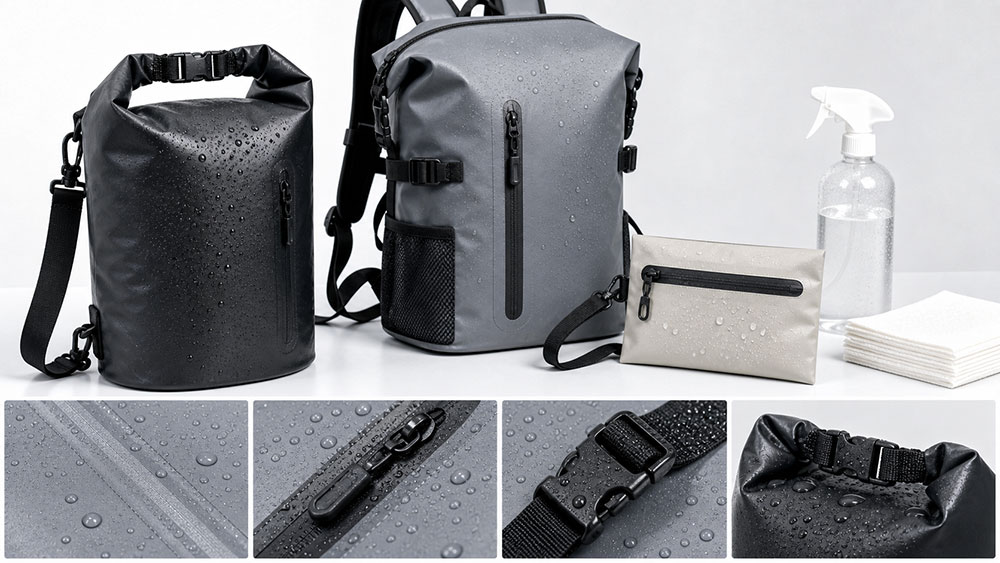
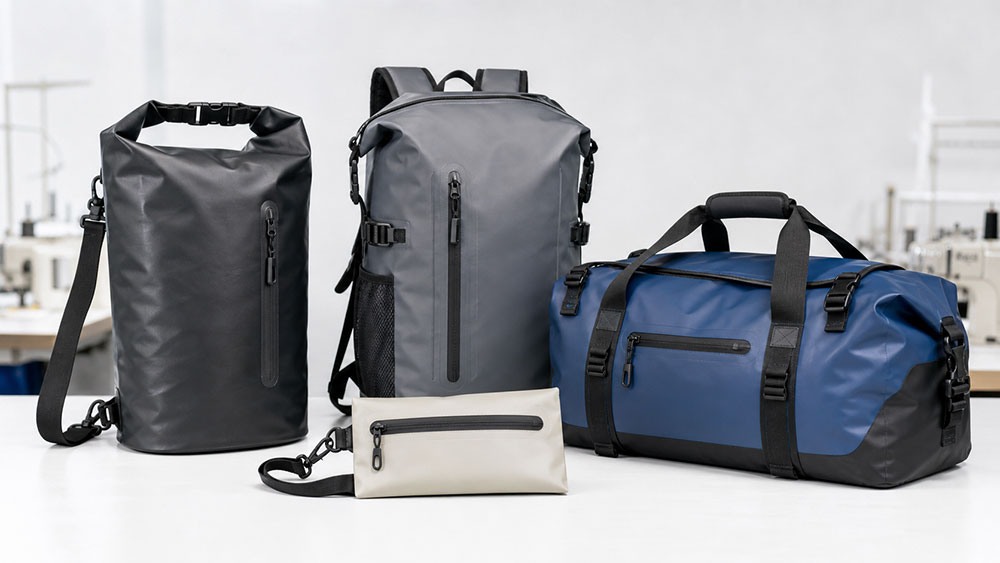
Choosing the right waterproof bag manufacturer is not only about finding the lowest price. For outdoor brands, importers, wholesalers, and private label buyers, the right manufacturer should understand waterproof materials, welded construction, product testing, customization, factory capacity, quality control, and long-term production stability.
A low unit price may look attractive at first, but weak welding, unstable materials, poor accessories, unclear communication, or limited production capacity can create serious problems after bulk production starts. The goal is to find a manufacturer that can support your product idea from sample development to repeat orders with consistent quality.
This guide explains how to evaluate a waterproof bag manufacturer step by step before placing an OEM, ODM, wholesale, or private label order.
Quick Answer: What Makes a Good Waterproof Bag Manufacturer?
A suitable waterproof bag manufacturer should have real waterproof bag experience, strong material knowledge, stable welding or sealing processes, clear sample development, reliable quality control, suitable factory capacity, flexible customization options, and transparent communication.
| Evaluation Point | What to Check | Why It Matters |
| Product experience | Dry bags, waterproof backpacks, duffel bags, pouches, cooler bags | Different bag types require different structures |
| Materials | PVC, TPU, tarpaulin, coated nylon, clear PVC | Material choice affects cost, durability, weight, and positioning |
| Waterproof construction | RF welding, high-frequency welding, roll-top closure, waterproof zipper | Structure decides real waterproof performance |
| Factory scale | Workers, equipment, production lines, output capacity | Important for bulk orders and repeat orders |
| Sample process | Prototype, logo sample, pre-production sample | Helps avoid problems before bulk production |
| Quality control | Seam test, leakage check, accessory test, appearance inspection | Reduces return risk and quality disputes |
| Customization | Size, color, logo, packaging, accessories | Important for private label and brand projects |
| MOQ and lead time | Sample time, bulk lead time, reorder flexibility | Affects launch schedule and inventory planning |
| Compliance support | REACH, phthalates, heavy metals, or other market needs | Important for EU, US, children’s, and retail markets |
1. Start With Your Product Type
Before searching for a factory, define the product you want to develop. “Waterproof bag” is a broad category. A factory that makes basic roll-top dry bags may not be the best choice for waterproof backpacks, waterproof zipper pouches, or technical fishing bags.
Common waterproof bag categories include:
- Roll-top dry bags
- Waterproof backpacks
- Waterproof duffel bags
- Waterproof phone pouches
- Waterproof cooler bags
- Waterproof toiletry bags
- Waterproof fishing bags
- Waterproof bicycle bags
- Waterproof motorcycle bags
- Waterproof storage pouches
Each product type has different design requirements. For example, a roll-top dry bag depends heavily on material thickness, welding quality, and closure design. A waterproof backpack also needs shoulder strap strength, back panel comfort, buckle durability, and load-bearing testing. A waterproof phone pouch may require clear PVC, touchscreen usability, sealing reliability, and neck strap safety.
If you are building a wider outdoor gear collection, reviewing related categories such as waterproof bags can help you decide which supplier capabilities you need.
2. Check Whether the Manufacturer Understands Waterproof Materials
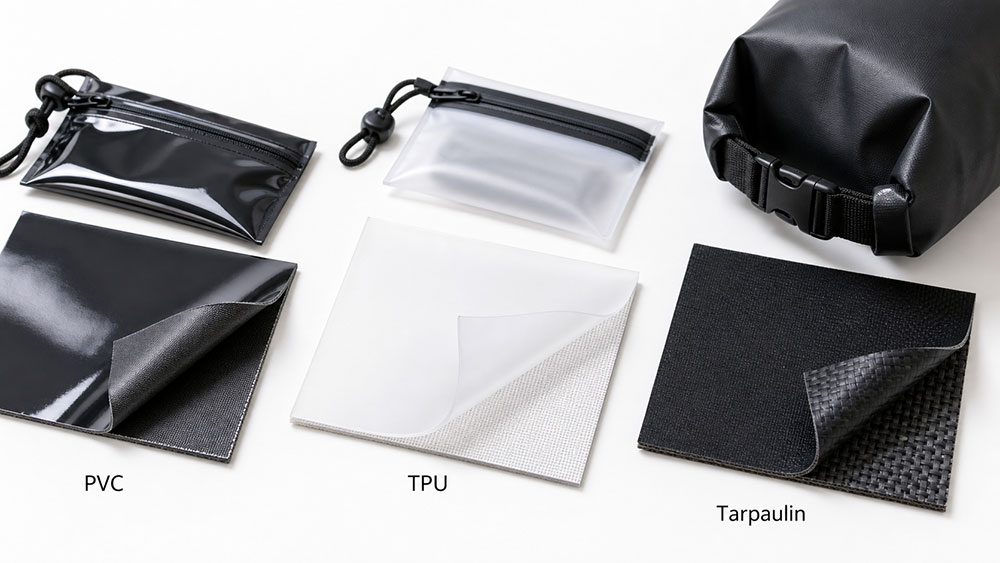
Material selection is one of the first signs of whether a manufacturer truly understands waterproof bag production.
Common waterproof bag materials include PVC, TPU, PVC tarpaulin, TPU-coated fabric, clear PVC, and coated nylon. Each material has its own advantages.
| Material | Common Use | Advantages | Things to Confirm |
| PVC | Dry bags, duffel bags, basic waterproof pouches | Cost-effective, durable, suitable for welding | Thickness, flexibility, odor, cold resistance |
| TPU | Premium dry bags, soft pouches, eco-positioned products | Softer hand feel, lighter, better flexibility | Cost, color stability, MOQ |
| PVC Tarpaulin | Heavy-duty bags, marine use, outdoor storage | Strong, abrasion-resistant, stable for bulk production | Fabric weight, coating quality |
| Clear PVC | Phone pouches, cosmetic bags, document pouches | Transparent, easy for product display | Yellowing, thickness, sealing performance |
| Coated Nylon | Lightweight outdoor bags | Lighter and softer than heavy PVC | Whether seams are sewn, taped, or welded |
A good manufacturer should be able to explain why one material is better for your target market. A budget promotional dry bag may use PVC, while a premium outdoor pouch may need TPU. A waterproof toiletry bag may use transparent PVC or TPU with a waterproof zipper. A heavy-duty duffel bag may require reinforced tarpaulin and stronger welded seams.
Do not only ask, “What is the price?” Ask, “Which material do you recommend for my market, and why?”
3. Understand the Waterproof Construction Method
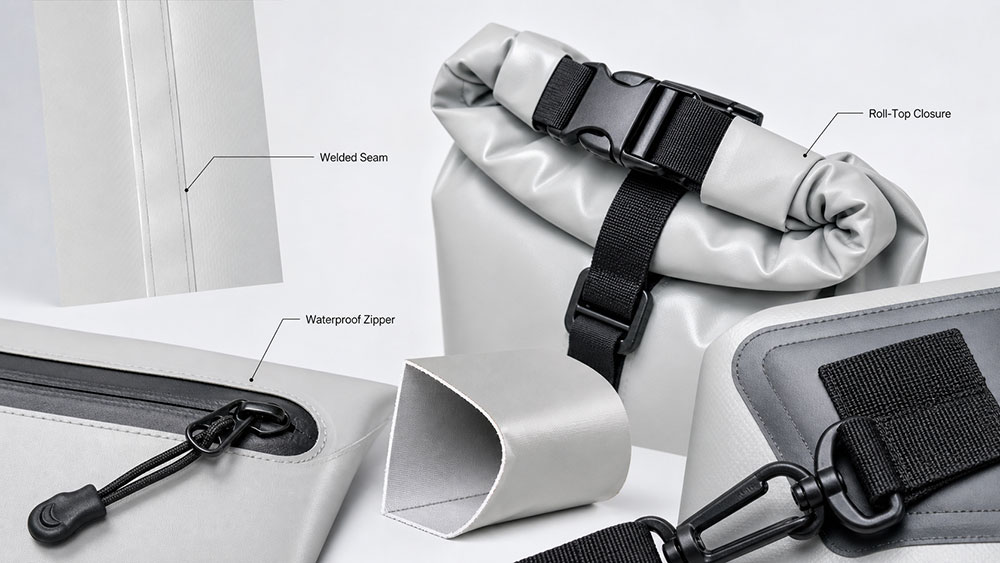
Waterproof bags are not made waterproof by material alone. The construction method is equally important.
Many waterproof bags use RF welding or high-frequency welding. This process bonds compatible materials together without traditional stitching holes, helping create sealed seams. Roll-top closures are common for dry bags because they are simple, reliable, and suitable for water sports and outdoor use. Waterproof zippers are often used for premium pouches, duffel bags, toiletry bags, and bags that need easier access.
When evaluating a manufacturer, ask about:
- Welding method
- Seam width
- Welding strength
- Closure design
- Waterproof zipper type
- Reinforcement points
- Corner sealing
- Strap attachment method
- Air pressure or leakage testing
Be careful with suppliers who describe every product as “100% waterproof” without explaining the structure. Waterproof performance depends on the material, seams, closure, zipper, design, and correct use.
For example, a roll-top bag may perform well when rolled three or more times and clipped correctly, but it may not be suitable for long-term underwater submersion unless the product is specifically designed and tested for that use. If a supplier mentions IP ratings, buyers should understand that IEC IP ratings are based on defined test conditions, so these claims should be supported by proper testing rather than used as a general marketing phrase.
4. Ask for Similar Product Experience
A suitable waterproof bag manufacturer should be able to show similar product experience. This does not mean they must have made the exact same design, but they should understand the structure and use case.
Ask for examples related to your product category:
- For water sports: dry bags, kayaking bags, paddle board bags, waterproof backpacks
- For fishing: waterproof fishing backpacks, waist packs, tackle pouches, fish storage bags
- For travel: waterproof toiletry bags, cosmetic pouches, wet/dry storage bags
- For cycling or motorcycles: waterproof handlebar bags, panniers, motorcycle duffels
- For retail programs: private label dry bags, logo pouches, promotional waterproof bags
If the supplier only shows generic backpacks or sewn travel bags, they may not be the right partner for fully welded waterproof products.
A manufacturer with waterproof bag experience should also understand how buyers use these products in real environments: kayaking, boating, fishing, camping, beach travel, diving, cycling, motorcycle touring, or wet storage. This helps them recommend better structures instead of simply copying a picture.
5. Evaluate OEM, ODM, and Private Label Capabilities
Different buyers need different levels of customization.
If you only need a logo on an existing product, private label service may be enough. If you need a new size, material, color, or accessory combination, OEM service is more suitable. If you want a new structure or product line, ODM support and product development ability become more important.
| Cooperation Type | Best For | What to Ask |
| Ready-made wholesale | Fast testing, small market trials | Available colors, stock, MOQ, packaging |
| Private label | Brand logo on existing style | Logo method, logo position, packaging options |
| OEM | Custom size, color, material, features | Technical drawing, sample cost, mold needs |
| ODM | New product development | Design support, prototype process, development timeline |
A good waterproof bag manufacturer should explain what can be customized and what may affect cost or MOQ. Common customization options include:
- Bag size and capacity
- Material type and thickness
- Color
- Logo printing
- Heat transfer logo
- Rubber patch
- Laser marking or embossing
- Zipper type
- Buckle and strap
- Shoulder strap design
- Window panel
- Valve
- Packaging
- Carton mark
- Retail label or hangtag
If you need more than one waterproof product category, choose a supplier that can support a wider outdoor collection, such as dry bags, waterproof backpacks, and waterproof gear for outdoor and water sports markets.
6. Review the Sample Development Process
Never place a bulk order based only on photos.
A professional manufacturer should have a clear sample process. For waterproof bags, samples are not just for appearance. They help confirm material feel, color, seam quality, closure performance, logo effect, packaging, size, and accessory strength.
A normal sample process may include:
- Product requirement confirmation
- Material recommendation
- Quotation
- Prototype or existing sample
- Logo sample
- Sample testing
- Sample feedback and adjustment
- Pre-production sample before bulk production
When reviewing a sample, check:
- Is the welding line smooth and consistent?
- Are there bubbles, burns, wrinkles, or weak corners?
- Does the closure seal correctly?
- Does the zipper move smoothly?
- Are buckles and straps strong enough?
- Is the logo position accurate?
- Does the material match your target price level?
- Is the bag comfortable to carry?
- Does the packaging match your sales channel?
If possible, test the sample in a realistic way. Fill it with soft items, seal it correctly, expose it to splashes or controlled water conditions, and check whether the inside stays dry. Do not use extreme tests unless the supplier has designed the product for that level.
7. Check Factory Scale and Production Capacity
Factory scale is an important factor when choosing a waterproof bag manufacturer, especially if you plan to place bulk orders, repeat orders, or develop a full product collection. A factory with stable production lines, trained workers, material preparation areas, welding equipment, inspection space, and packing capacity is usually better prepared for long-term B2B cooperation.
However, factory size should not be the only standard. A very large factory may not be flexible for small custom projects, while a smaller specialized factory may offer better communication and faster product adjustment. The key is to check whether the factory scale matches your order quantity, customization needs, quality expectations, and delivery schedule.
When evaluating production capacity, ask about:
- Factory area and number of workers
- Main production equipment
- Monthly or annual output
- Peak season production capacity
- Number of production lines
- Sample development team
- QC team and inspection process
- Ability to support repeat orders
For waterproof bags, scale is not only about how many bags a factory can make. It is also about whether the manufacturer can keep welding quality, material consistency, logo accuracy, packing quality, and delivery time stable during bulk production.
8. Look at Quality Control, Not Just Certificates
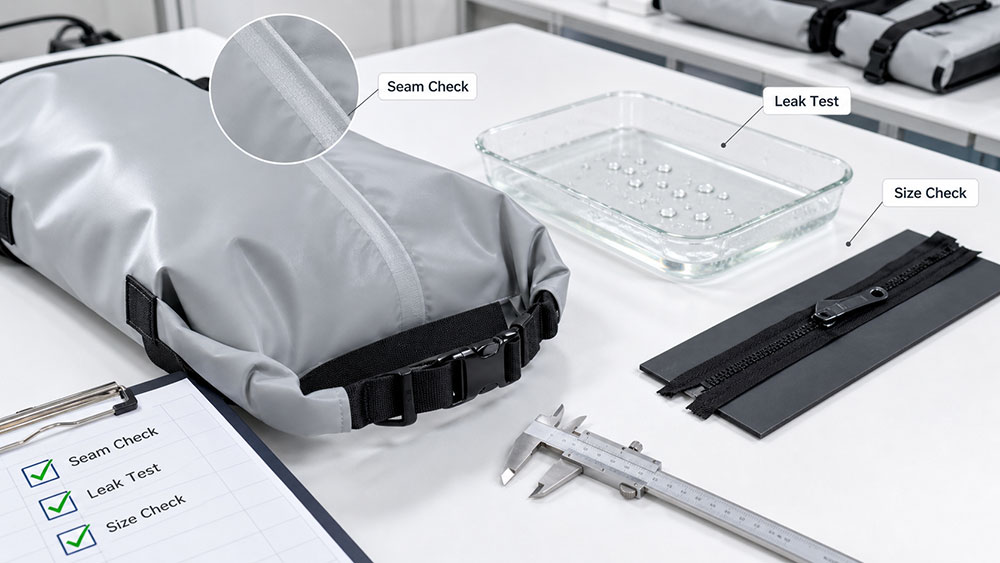
Certificates can be useful, but they are not enough. A supplier may show a certificate while still having weak production control. For waterproof bags, quality control must happen during material preparation, cutting, welding, assembly, logo application, inspection, and packing.
Important QC checkpoints include:
- Material thickness and color check
- Cutting accuracy
- Welding temperature and pressure control
- Seam strength inspection
- Leakage or air pressure test
- Zipper and closure test
- Buckle and strap pull test
- Logo inspection
- Size measurement
- Appearance check
- Carton and packing inspection
ISO 9001 can be a helpful reference because it is a globally recognized quality management standard, but buyers should still ask how the factory controls each production step. A real QC process should be visible in production records, inspection photos, test reports, or pre-shipment inspection documents.
If the product is sold in the EU, materials may need to consider the EU REACH Regulation, which focuses on reducing risks from chemicals to human health and the environment. If the product is designed for children, additional chemical and safety requirements may apply depending on the target market. Always confirm compliance requirements before sample development, not after production.
9. Compare MOQ, Price, and Lead Time Together
Many buyers ask for the lowest MOQ and lowest price first. That is understandable, but MOQ, price, and lead time should be evaluated together.
A very low MOQ may mean the supplier uses existing materials only. A lower price may mean thinner material, cheaper buckles, weaker straps, or simpler packaging. A shorter lead time may be possible for existing styles, but not for fully customized products.
Ask the supplier:
- What is the MOQ for existing styles?
- What is the MOQ for custom logo?
- What is the MOQ for custom color?
- What is the MOQ for custom material?
- What is the sample time?
- What is the bulk production lead time?
- What happens during peak season?
- Can the supplier support repeat orders?
- Can they reserve materials for future production?
For many custom waterproof bag projects, sample development may take one to two weeks, while bulk production may take several weeks depending on order quantity, material availability, logo process, and factory schedule.
A reliable manufacturer will explain what affects MOQ and lead time instead of giving one simple answer for every project.
10. Check Communication and Problem-Solving Ability
Good communication is part of good manufacturing.
A suitable waterproof bag manufacturer should ask detailed questions before quoting. If a supplier only says “yes, we can make it” to every request, that is not always a good sign. Waterproof bag production has many technical details, and a responsible supplier should clarify them early.
Pay attention to whether the supplier asks about:
- Product use scenario
- Target market
- Material preference
- Capacity or dimensions
- Waterproof level expectations
- Logo method
- Packaging
- Sales channel
- Compliance requirements
- Budget range
- Timeline
Good suppliers do not only accept instructions. They help identify risks before production. For example, they may tell you that a certain logo method is not suitable for a textured TPU surface, or that a waterproof zipper will increase cost and MOQ. This type of feedback can save time and money.
11. Identify Red Flags Before Placing an Order
Some problems are visible before production starts. Watch for these red flags:
- The supplier cannot explain material differences
- Every product is described as “100% waterproof” without test details
- Photos look inconsistent or copied from many sources
- The MOQ changes repeatedly without explanation
- The sample quality does not match the promised standard
- The supplier refuses pre-production sample confirmation
- The quote is much lower than all other suppliers
- The factory cannot show production or QC details
- Communication becomes unclear after payment
- Packaging and shipping details are vague
One red flag does not always mean the supplier is bad, but several red flags together mean you should slow down.
12. Use a Supplier Evaluation Scorecard
A scorecard helps compare suppliers more objectively.
| Criteria | Score 1–5 | Notes |
| Waterproof bag experience | Similar product types and real production cases | |
| Material knowledge | Can explain PVC, TPU, tarpaulin, coated fabrics | |
| Welding and sealing ability | RF welding, waterproof zipper, roll-top structure | |
| Sample quality | Seam, closure, logo, material, accessories | |
| Factory capacity | Production lines, workers, equipment, output stability | |
| QC process | Inspection steps, testing method, reports | |
| Customization support | OEM, ODM, logo, packaging, accessories | |
| MOQ flexibility | Suitable for your launch stage | |
| Lead time reliability | Sample time, bulk time, reorder plan | |
| Compliance support | REACH, phthalates, heavy metals, market needs | |
| Communication | Fast, clear, technical, problem-solving focused |
After scoring several suppliers, do not automatically choose the cheapest one. Choose the one that best matches your product positioning, risk tolerance, and long-term market plan.
13. Questions to Ask a Waterproof Bag Manufacturer
Before ordering samples, send a clear inquiry. Here are useful questions:
- Have you made similar waterproof bags before?
- What material do you recommend for my target market?
- What welding or sealing method do you use?
- Can you support custom size, color, logo, and packaging?
- What logo methods are suitable for this material?
- What is the MOQ for existing styles and custom designs?
- What is the sample time and bulk production lead time?
- What is your factory scale and production capacity?
- How do you test waterproof performance?
- Can you provide inspection photos or QC reports?
- What compliance documents can you support?
- Can you make a pre-production sample before bulk production?
- How do you handle quality issues after delivery?
The quality of the supplier’s answers often tells you more than the price list.
14. When Yoxindaa May Be a Suitable Partner
If your business needs custom waterproof bags for outdoor, water sports, travel, fishing, or retail channels, Yoxindaa can support OEM, ODM, wholesale, and private label waterproof bag projects.
Yoxindaa focuses on waterproof gear and inflatable water sports products, with experience in RF welded waterproof bags, TPU and PVC materials, custom logo options, and B2B production support. With a production facility of over 5,000 square meters, more than 200 workers, and annual output of over 150,000 units, Yoxindaa can help buyers manage sampling, customization, bulk production, and repeat orders more efficiently.
For buyers developing a waterproof bag collection, categories such as dry bags and waterproof backpacks can be planned together to keep material, branding, packaging, and product positioning consistent.
This is especially useful for brands that need more than one product style and want a supplier that understands outdoor use, water exposure, product customization, and bulk order coordination.
Conclusion
Choosing the right waterproof bag manufacturer requires more than browsing product photos or comparing unit prices. You need to evaluate product experience, material knowledge, waterproof construction, sample quality, factory scale, QC process, customization support, MOQ, lead time, compliance, and communication.
The best supplier is not always the cheapest. It is the one that understands your product type, helps reduce development risk, supports your market positioning, and delivers stable quality from sample to bulk production.
Before placing a bulk order, define your product clearly, request samples, test the structure, confirm packaging, review QC steps, and compare suppliers with a practical scorecard. This approach will help you build a more reliable waterproof bag supply chain and avoid costly mistakes.
FAQ
1. How do I choose a reliable waterproof bag manufacturer?
Start by defining your product type, material, target market, and customization needs. Then compare manufacturers based on waterproof bag experience, material knowledge, welding ability, sample quality, factory capacity, QC process, MOQ, lead time, and communication. Always request samples before bulk production.
2. What is the difference between a waterproof bag manufacturer and a trading company?
A manufacturer usually has production equipment, workers, material handling, welding or sewing processes, and QC control. A trading company mainly sources products from different factories. Some trading companies are helpful, but for custom waterproof bags, working directly with a manufacturer can improve technical communication and production control.
3. Should factory scale matter when choosing a waterproof bag manufacturer?
Yes, factory scale matters, especially for bulk orders, repeat orders, and long-term cooperation. However, factory size should not be the only standard. Buyers should check whether the factory’s capacity, equipment, workers, QC process, and flexibility match their order quantity and customization needs.
4. What materials are best for waterproof bags?
PVC, TPU, PVC tarpaulin, coated nylon, and clear PVC are commonly used. PVC is cost-effective and durable. TPU is softer, lighter, and often used for premium products. Tarpaulin is suitable for heavy-duty bags. The best material depends on your product type, target price, and market positioning.
5. What should I check in a waterproof bag sample?
Check the material feel, welding line, closure, zipper, strap strength, buckle quality, logo position, size accuracy, packaging, and basic waterproof performance. A sample should be reviewed for both appearance and function.
6. What is a normal MOQ for custom waterproof bags?
MOQ depends on material, size, color, logo method, packaging, and whether the design is existing or fully customized. Existing styles with logo customization usually have lower MOQ than new custom designs. Always confirm MOQ separately for stock styles, custom logo, custom color, and custom material.
7. How long does waterproof bag production take?
Sample development often takes one to two weeks, while bulk production may take several weeks depending on order quantity, material availability, logo process, and production schedule. Lead time should be confirmed before placing the order, especially during peak season.
8. Can waterproof bags be made with a custom logo?
Yes. Common logo methods include silk screen printing, heat transfer printing, UV printing, rubber patch, laser marking, and embossing. The best method depends on the material surface, order quantity, logo design, and target price.
9. Are all waterproof bags fully submersible?
No. Waterproof performance depends on material, seam construction, closure, zipper, and test conditions. Some bags are suitable for rain and splashes, some are suitable for water sports, and some may be designed for temporary submersion. Always confirm the expected use and testing method with the manufacturer.
10. Should I choose the cheapest waterproof bag supplier?
Not always. The cheapest supplier may use thinner materials, weaker accessories, or less stable QC. A better choice is the supplier that offers the right balance of price, quality, communication, lead time, and long-term production reliability.